

The pharmaceutical industry is changing rapidly. Everyone is looking toward big things. Big molecules. Big indications. Big efficacy. Out of the top 10 biopharmaceutical companies, 6 have a large-molecule, biologic as their lead product.
That figure isn’t likely to go down soon. Biologics continue to transcend classification with several achieving the much sought-after “pipeline in a product” designation.
Humira, that perennial overachiever, currently boasts 9 indications, while Keytruda touts an astounding 30 indications.[1,2] To meet market demand, scientists must rush to discover the next biologic blockbuster while scaling and optimizing their bioprocessing workflows as fast as possible.
Building bigger with bioprocessing
Creating complex molecules through organic chemistry techniques is nearly impossible. It’s simply a matter of scale. The molecular structures of biologics, such as IgG antibodies, are 1000 times larger than Aspirin molecules.[3] Creating a molecule that size in a laboratory would be like flying a rocket to the moon. It would literally require hundreds of scientists working for years to achieve that.
Ironically, this technological feat is not necessary because it can be replaced with one of humanity’s oldest technologies—fermentation, AKA upstream bioprocessing.
More gardener than architect
Instead of building molecules piece by piece, scientists leverage biological systems like cells, bacteria, and viruses to manufacture specific therapeutic molecules such as antibodies, viral vectors, insulin, and more.
However, when those molecules of interest are created, they are not readily available. They are either trapped within the cells that produced them (intra-cellular) or mixed with other proteins outside of cells (extra-cellular).
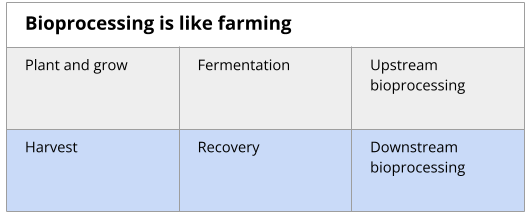
The task, then, is to extract proteins of interest from these heterogeneous solutions. However, biopharma companies face several challenges when trying to optimize bioprocessing purification.
Identifying problems in the profit linchpin
The major issue companies face when trying to optimize bioprocessing purification is cost management. Bioprocessing is inherently slow and expensive when compared with traditional pharmaceutical production. Industry reports place small molecules at $5 a batch compared with $60 per batch for biologics—a 1200% increase.[4] Furthermore, yields for small molecules are often measured in kilograms. However, large-scale production for a biologic, like a monoclonal antibody, is anything over 100 grams.[5]

Consequently, the value-per-mg for biologics is significantly higher. This is further exaggerated when creating personalized medicines that have a definitive ceiling on scalability (take a neoantigen-specific antibody for example).
These economic and resource pressures imbue particular significance into the purification process. Because that slime scientists are extracting from chromatography machines isn’t slime at all. It’s gold, from both a therapeutic and an economic perspective.
On the one hand, this means that any added efficiency with bioprocessing purification has a tangible benefit on a company’s bottom line. On the other hand, any unexpected downtimes create fire drills and tangible damage to a company’s bottom line.
“Best guess” strategy
Some common issues with bioprocessing purification could be seen as regular maintenance. Columns have a shelf life and will fail at some point. Similarly, control runs will report inaccuracies eventually. However, most chromatography processes lack the proper data infrastructure to track when and how these issues occur.
At an organizational level, lack of systemic data is also an issue. Many CapEx estimates are de jure based on instrument usage. However, anyone who has been a part of CapEx meetings knows that instrument usage estimates are often based on gut feelings rather than hard data. Self-evident irony aside, this means that investment into lab equipment could (and probably is) flowing in sub-optimal patterns at an enterprise scale.
Stuck at the crossroads of data creation and caretaking
Creating data is something biopharmaceutical companies are comfortable with. After all, pioneering new discoveries and developing life-changing therapies is what they do. However, managing existing data has become a bugaboo for many biopharma companies, especially as the amount of data has exploded in the last two decades and continues to grow exponentially.
An FPLC lab could be wasting 1000s of hours per year on manual data handling.
Chromatography, their key purification tool, currently requires manual data transfers to operate within laboratory environments that utilize informatics and analytics applications. However, manual data handling limits productivity and scalability of lab operations. For example, moving data from a chromatography data system (CDS) to an electronic lab notebook (ELN) requires a manual data transfer. That process can take up to 2 hours. Consider the steps in the average workflow:
- Click to open UNICORN software
- Navigate to the right results
- Hit the export CSV button
- Move file to a different computer or hard drive
- Open file in Excel
- Format the headers
- Format the cells
- Perform basic aggregation
- Create tables to screenshot
- Plot chromatograms and edit the format
- Manually enter data into the ELN tables
A lab that completes several hundred runs per month could be spending close to 100 hours on these steps alone.
Even more troubling is the amount of time spent preparing data for analytics. Scientists and data scientists have been using applications to run chromatography visualizations for years. But it is still difficult to access data directly. This means that most people running data analytics are forced to use Excel exports. This requires manual data transformation—a tedious, time-consuming, and error-prone process that costs some labs 1000s of hours per year.
Traditional fast-protein liquid chromatography (FPLC) workflow

Bigger, badder, faster analytics applications?
It may be tempting to look at data issues and subscribe to a worldview where purchasing newer, more advanced analytics applications is the answer (perhaps something with AI/ML?).
Unfortunately, data and inner peace are much the same. Wherever you go, there it is. The issues of unstandardized/unharmonized data within existing data applications will carry over to newer applications as well. In fact, clean, FAIR (findable, accessible, interoperable, and reusable) data becomes more necessary the more sophisticated the data applications are.
The struggle to see ROI in DIY
Some companies have turned to in-house IT solutions to solve data issues with bioprocessing purification. Many, however, find that establishing, maintaining, and updating data workflows is far more resource- and cost-intensive than they expected. Even with these investments, user experience is often poor, as point-to-point integrations are brittle and unreliable, updating workflows with new equipment is cumbersome and can result in downtime, and most solutions lack the appropriate data engineering to prepare data for advanced analytics and visualizations.
A solution from experts for experts
The goal for higher yields and lower costs in bioprocessing purification workflows is only going to increase as biologics continue to dominate headlines and clinics alike. Combine that with tepid efficacy from in-house IT solutions, and suddenly a landscape emerges where biopharmaceutical leaders need to find external solutions to their workflow issues. That’s where TetraScience comes in.
At TetraScience, we are a unique blend of people who understand how data works and how biopharma laboratories work. We combined that experience to create the Tetra Scientific Data CloudTM.
The Tetra Scientific Data Cloud is the only end-to-end scientific data solution that was purpose built to solve scientific data problems in biopharmaceutical laboratories, including those associated with bioprocessing purification.
The Tetra Scientific Data cloud can integrate with FPLC instruments and software, including ÄKTA and UNICORN, as well as informatics applications and analytics applications to automate data transfers, completely eliminating manual data transfers. Additionally, the Tetra Scientific Data Cloud also enables the extraction of metadata such as dates, method parameters, column chemistry, system performance and more. Compiling this data in the cloud allows companies to track FPLC performance over time, predict failures before they happen, and eliminate unscheduled downtimes.
Bioprocessing purification workflow with the Tetra Scientific Data Cloud

The Tetra Scientific Data Cloud also automates data processing—engineering data and enriching it with metadata to create FAIR, compliant, harmonized, liquid, actionable data that power advanced analytics, visualization tools, and AI/ML so companies can derive insights from their data quickly and easily.
Bringing learnings forward
Just as bioprocessing purification workflows have improved over the years, so have data workflow solutions. TetraScience has stepped into some of the top labs in the world (17 out of the top 25 biopharmas trust us with their data) and created solutions that are delivering real world results today.
We have taken those lessons and created a pre-built solution that helps organizations get up and running with their scientific data quickly rather than spending months hiring personnel, building and testing a custom solution, and potentially never achieving ROI. With our productized offering, biopharmas receive best-practice solutions for their bioprocessing purification workflows so they can start seeing better yields, at a lower cost, faster. By doing so, they can accelerate biologics innovation and continue to improve and extend human life.
To learn more about how the Tetra Scientific Data Cloud can accelerate and improve your bioprocessing purification workflows, you can visit our website.
Are you a more tactile or visual learner? Request a demo today.
References:
[1] AbbVie Inc. (2021). HUMIRA® (adalimumab). Package Insert. https://www.rxabbvie.com/pdf/humira.pdf.
[2] Merck & Co., Inc. Selected Indications for KEYTRUDA® (pembrolizumab). https://www.keytrudahcp.com/approved-indications.
[3] AZBio. Small Molecules, Large Biologics, and the Biosimilar Debate. https://www.azbio.org/small-molecules-large-biologics-and-the-biosimilar-debate.
[4] Makurvet FD. Biologics vs. small molecules: Drug costs and patient access. Med Drug Discov. 2021.
[5] National Research Council (US) Committee on Methods of Producing Monoclonal Antibodies. Large-scale production of monoclonal antibodies. In Monoclonal Antibody Production. Washington (DC): National Academies Press (US); 1999.